Almost everyone searching for AI short drama wants to watch one, not make one
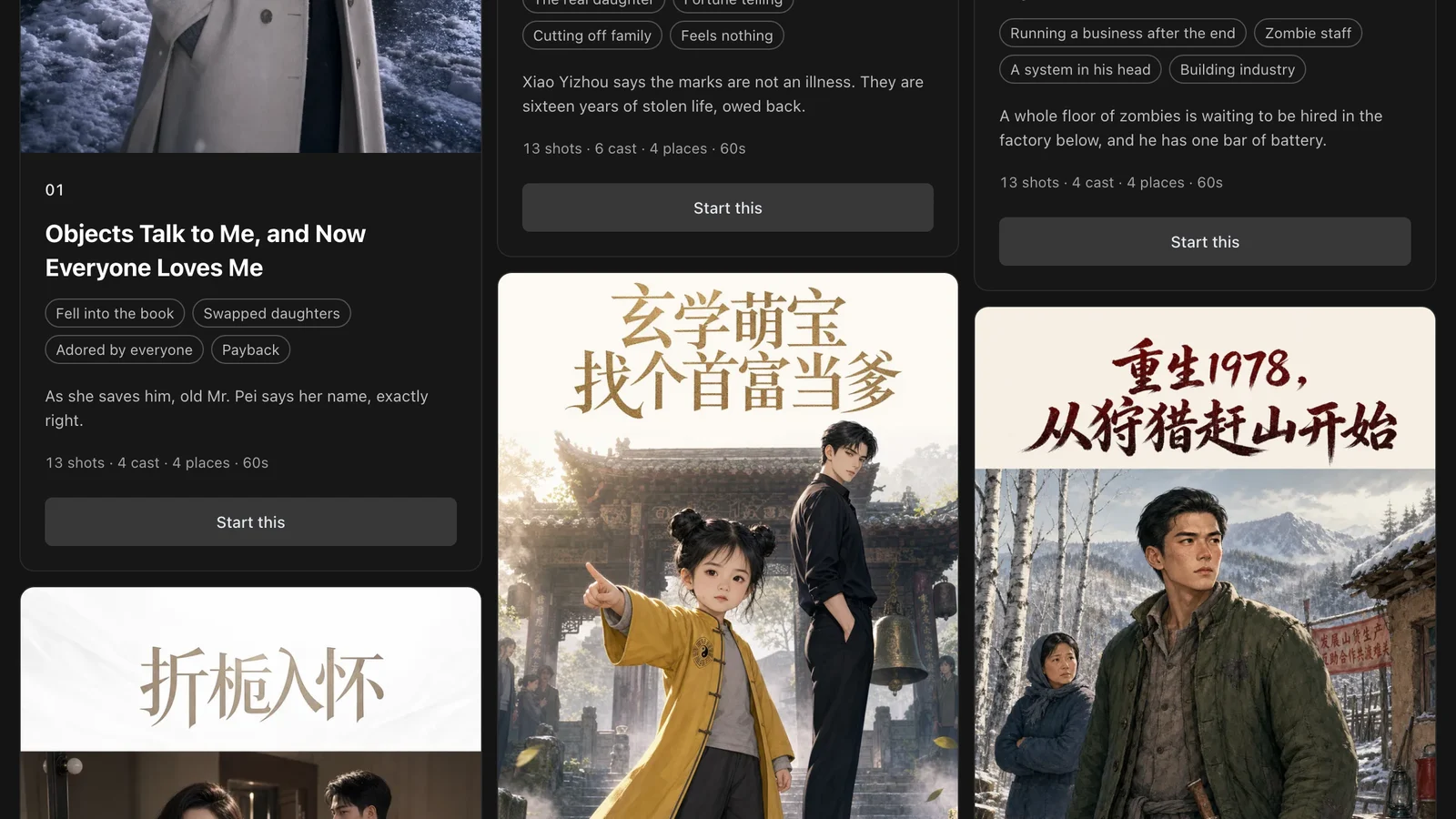
On August 11, 2026 we pulled Google's public autocomplete endpoint for `ai short drama` and ran a 23-letter sweep across `ai short drama a` through `ai short drama w`. The nine completions Google returned for the bare term were: dailymotion, series, list, app, movie, app free, bl, romance, reddit.
Every one of those is somebody looking for an episode to watch tonight. Not one is somebody looking for a tool. The alphabet sweep went further and returned roughly forty specific episode titles people search by name, from `torn between us` to `identity zero` to `arena zero`.
Two audiences wearing the same words
The people who watch short drama and the people who make it type nearly identical things into a search box, and they want opposite outcomes. A viewer typing `ai short drama romance` wants forty episodes to scroll. A maker typing `ai romance drama generator` wants a tool.
The maker language exists and it is narrower: generator, maker, creator, script generator, storyboard generator, consistent character, faceless channel, and the direct question `how are ai short dramas made`. Those are the terms with intent behind them. They are also much smaller, and confusing the two is how a product in this category ends up building for the wrong person.
Why the split matters to somebody making one
Because it tells you what your own audience is doing. People search for a short drama by its title, which means an episode with a real name and a real premise is findable and an episode called "AI Drama Episode 3" is not.
It also tells you that the audience for the format is much larger than the audience for the tools, which is the opposite of what a maker assumes when they are deep in the making. The thing you are competing for is somebody's next sixty seconds, against forty other episodes they could scroll to instead.
The practical version: name the episode like a drama, write the premise into the caption in plain words, and end on a hook. Those three cost nothing and they are the only parts of a video that a search box can read.
How we pulled this, so you can check it
Google publishes an autocomplete endpoint that returns real query completions and needs no key. We queried it for twenty English seeds and four Chinese ones, plus the letter sweep, on August 11, 2026.
One honest limit: that endpoint returns no volume numbers, so nothing here says how many people search anything. It proves people type these terms, which is a different and smaller claim than saying how many. Where a number is needed, Keyword Planner is the free instrument that gives banded volumes, and it is a separate pull.

Free to start
40 credits when you sign up
40 free credits, yours for 14 days. Go make something great.
- SOTA models
- Infinite canvas
- Director stage
- MCP access
Got questions left?
Does this mean making a tool for this is a bad idea?
No, it means the two audiences need to be told apart. The maker terms are real and they carry commercial intent; they are just far smaller than the viewing terms. Building for makers while measuring yourself on viewing traffic is the mistake, not building for makers.
Why does searching by episode title matter?
Because it is free distribution for a named episode. About forty specific drama titles came back in one alphabet sweep, which means the audience already treats these as shows with names rather than as generic AI clips. An episode with a real title and a written premise can be found by that behaviour. An untitled one cannot.
Where can I see the maker search terms?
The full list came out of the same pull: generator, maker, creator, director, production, drama script generator, script to video, storyboard generator, consistent character video generator, faceless youtube channel, and the question `how are ai short dramas made`. Every one of those is a term Google's own autocomplete returned, which is why they are listed and other plausible-sounding terms are not.