Script to video: what actually has to happen in between
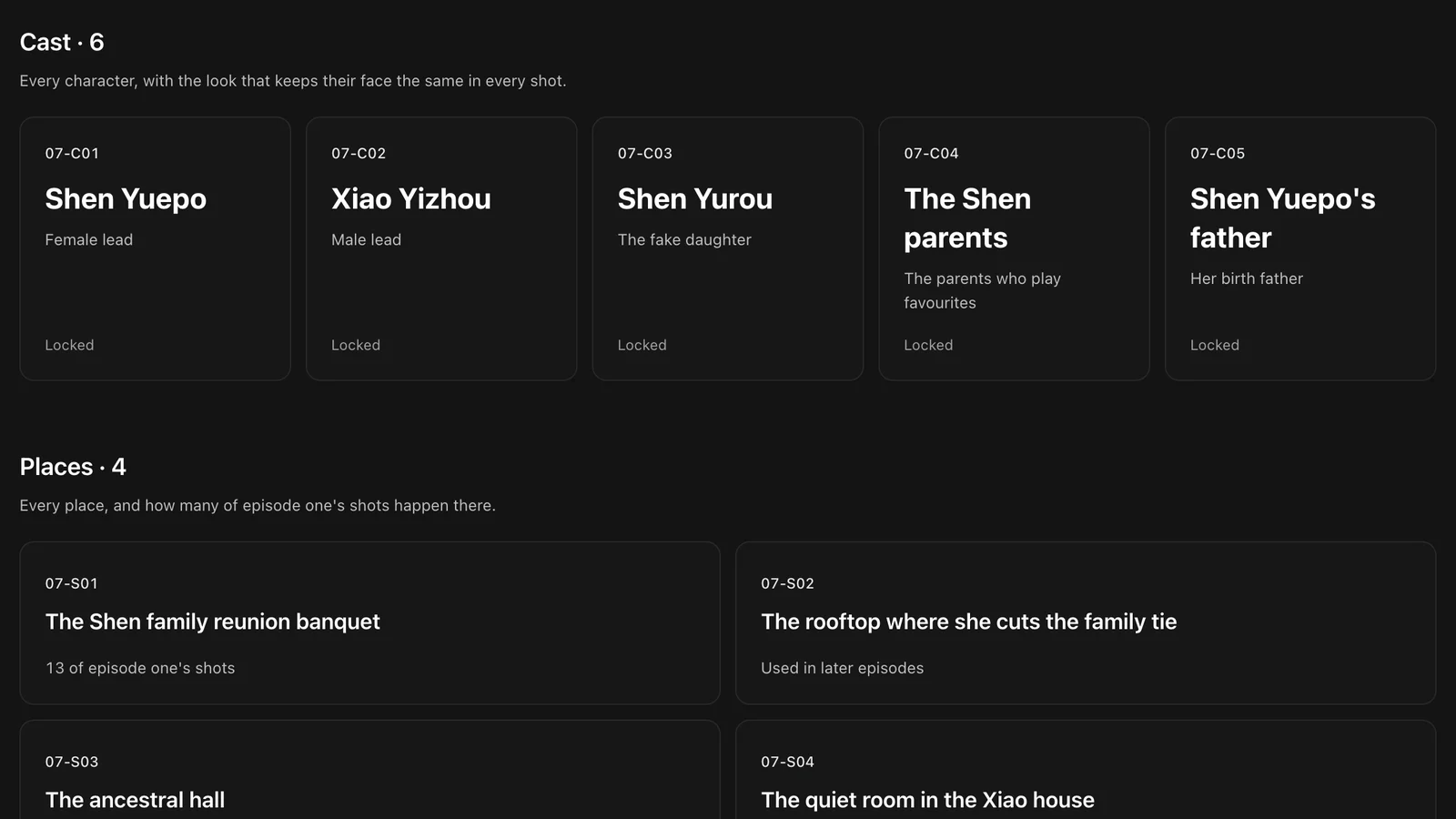
Script to video sounds like one step and it is six. A page of dialogue does not say who is on screen, how close the camera is, which way anybody is facing, what the light is doing, how long the shot runs or which model should make it. Something has to answer all six before a frame exists.
The difference between tools is not whether those decisions get made, it is whether you can see them and change them. Every shot in the twenty pilots in this product carries all six written out, which is why a shot can be re-run without rewriting the scene.
The six decisions
Every one of these is written per shot rather than per scene, because a scene with three shots in it needs three different answers to most of them.
| The decision | What goes wrong when nobody makes it |
|---|---|
| Who is in frame | A character appears in a shot the story never put in the room |
| How close the camera is | Every shot is the same size and the episode reads flat |
| Which way people face | Two people talking appear to look the same direction, so the cut breaks |
| What the light is doing | The same room changes time of day between two consecutive shots |
| How long the shot runs | A four-second beat gets eight seconds and the pace dies |
| Which model generates it | A wide establishing shot costs the same as a close-up on a face |
All six are fields on every shot in the twenty pilot files, alongside the generation prompts themselves.
Try generating with H3 Max TurboWhy they have to stay editable
Because generation is not deterministic. Some shots come back wrong, and when one does you want to change the thing that caused it rather than roll the dice again. If the only control you have is the prompt, a re-run is a coin flip with a price on it.
If instead you can see that the shot was written as a wide and the face is too small to read, you change it to a mid shot and re-run that shot alone. Nothing else in the episode moves, and you paid for one generation instead of thirteen.
Where the writing stays yours
The premise, the beats and every line of dialogue. A tool that rewrites your dialogue while converting it to shots is not converting, it is replacing, and you will find out at the wrong moment.
The right split is that you own the words and the tool owns the mechanics: the framing, the continuity anchors, the shot lengths and the bindings between a shot and the character references it uses. Those are bookkeeping, and bookkeeping is exactly what should be automated.
Free to start
40 credits when you sign up
40 free credits, yours for 14 days. Go make something great.
- SOTA models
- Infinite canvas
- Director stage
- MCP access
Got questions left?
Can I paste in a script I already wrote?
Yes. That is the better path when you have one, because the writing is the part worth keeping. What gets built around it is the shot list: framing, length, continuity and the model per shot.
What happens if I rewrite one scene later?
Only the shots in that scene are affected. A rewrite does not regenerate the episode, which matters because regenerating an episode you were mostly happy with is the most expensive mistake available in this kind of tool.
Does the script have to be in English?
No. The whole product runs in English and Simplified Chinese, and the twenty pilot episodes in it were written in Chinese first. Dialogue is generated and lip-synced in the language it was written in.