The eight-beat short drama structure, and what changes per genre
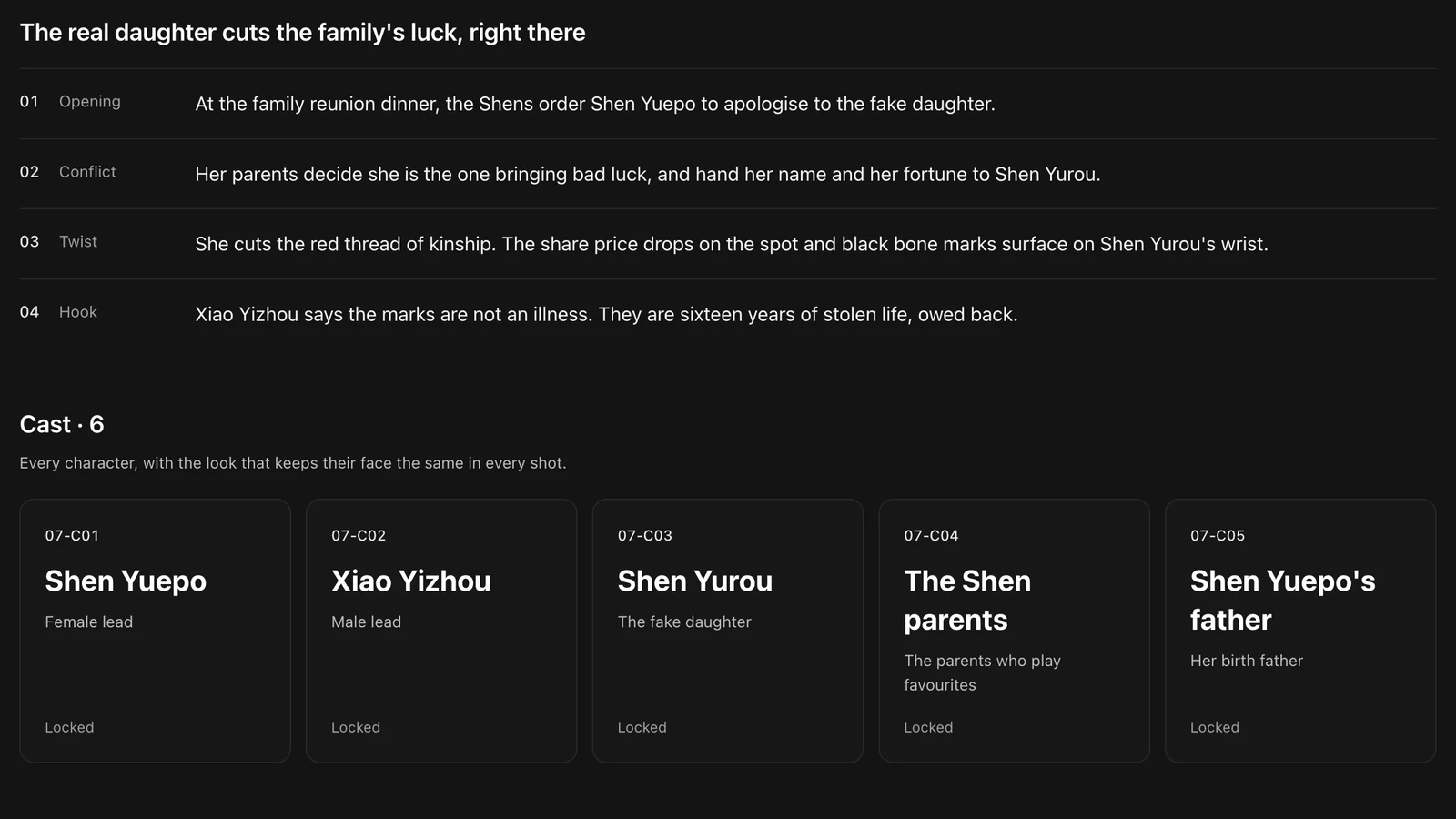
Short drama has a shape, and it is more fixed than people expect. Across the twenty-four genres in this product the beat count does not move: eight beats, in the same order, in a billionaire story and in a werewolf story alike. What changes is what the lead wants and what stands in the way.
That is useful, because it means you never start from nothing. Pick the want and the obstacle, drop them into the eight slots, and you have a spine before you have written a line of dialogue.
The eight beats
Read them as slots rather than as scenes. In a sixty-second episode several beats share a shot, and in a three-episode arc one beat can carry a whole episode.
| Beat | What has to happen |
|---|---|
| 1. The want, already running | Open on the lead already wanting it. Do not introduce the want, show it in motion |
| 2. The ordinary day breaks | Something forces the want out into the open |
| 3. A choice nobody asked for | The lead does something with no quiet way back from it |
| 4. The obstacle, worse than expected | What stands in the way turns out to cost more than the lead thought |
| 5. The reversal | What the lead believed about the closest person or plan turns out to be wrong |
| 6. The point of no return | Turning back now costs more than pressing on |
| 7. The collision | Everything meets in one scene, in front of everyone who matters |
| 8. New equilibrium, and a hook | What the lead has now is not what they wanted, and it is not finished |
This is the spine rendered on all 24 genre pages in this product, filled in per genre with that genre's own want and obstacle.
Try generating with H3 Max TurboWhat actually changes between genres
Two things, and only two. The want, which is what the lead is chasing hard enough that the audience can feel it in shot one. And the obstacle, which has to cost something real rather than just delay the ending.
A revenge drama and a contract marriage run the same eight beats. In one the want is to make someone pay and the obstacle is that the person who wronged the lead now holds the power. In the other the want is to be chosen for real and the obstacle is an agreement that says feelings are not part of the deal. Same slots, different contents.
The test for whether the obstacle is doing its job: if removing it would still leave the ending in the same place, it is a delay, not an obstacle.
Turning eight beats into thirteen shots
A sixty-second episode carries thirteen shots, so the beats do not map one to one. Beat one usually takes the first shot alone, and it is three seconds long, because the hook has to land before the fourth second. Beats two and three share two or three shots. The reversal and the point of no return usually get one shot each and they are the two the writing has to be sharpest on.
The collision earns the most room, three or four shots, because it is the payoff. And the last shot is the hook into the next episode, which is why every one of the twenty pilots in this product is written with three episodes already mapped rather than one.
If a beat cannot find a shot, it is not in the episode. That sounds harsh and it is the whole discipline of the format: a beat you cannot show in five seconds is a beat you are explaining, and explaining is what makes people scroll.

Free to start
40 credits when you sign up
40 free credits, yours for 14 days. Go make something great.
- SOTA models
- Infinite canvas
- Director stage
- MCP access
Got questions left?
Is eight beats a real convention or something you made up?
The count and the shape are shared craft convention across short drama, which is why it holds across all twenty-four genres rather than being rewritten for each. What is genre-specific is the want and the obstacle inside it, and those are written out per genre rather than generated.
What if my story does not fit eight beats?
Then it is probably more than one episode. The eight beats are sized for a single episode that ends on a hook. A premise with two reversals in it is a three-episode arc, and mapping it that way is better than compressing it until every shot is explaining.
Do I have to use a genre at all?
No. The genres exist so you do not start from a blank page, and each one comes with its want, its obstacle and four cast archetypes already written. If you have your own premise, put it straight into the eight slots and skip the genre entirely.