How an AI short drama actually gets made, shot by shot
Most explanations of this stop at "you type a prompt and it makes a video", which skips the entire job. An episode is not one generation. It is a structure that has to be decided before a single shot is generated, and getting that structure wrong is what makes an AI drama feel like a slideshow.
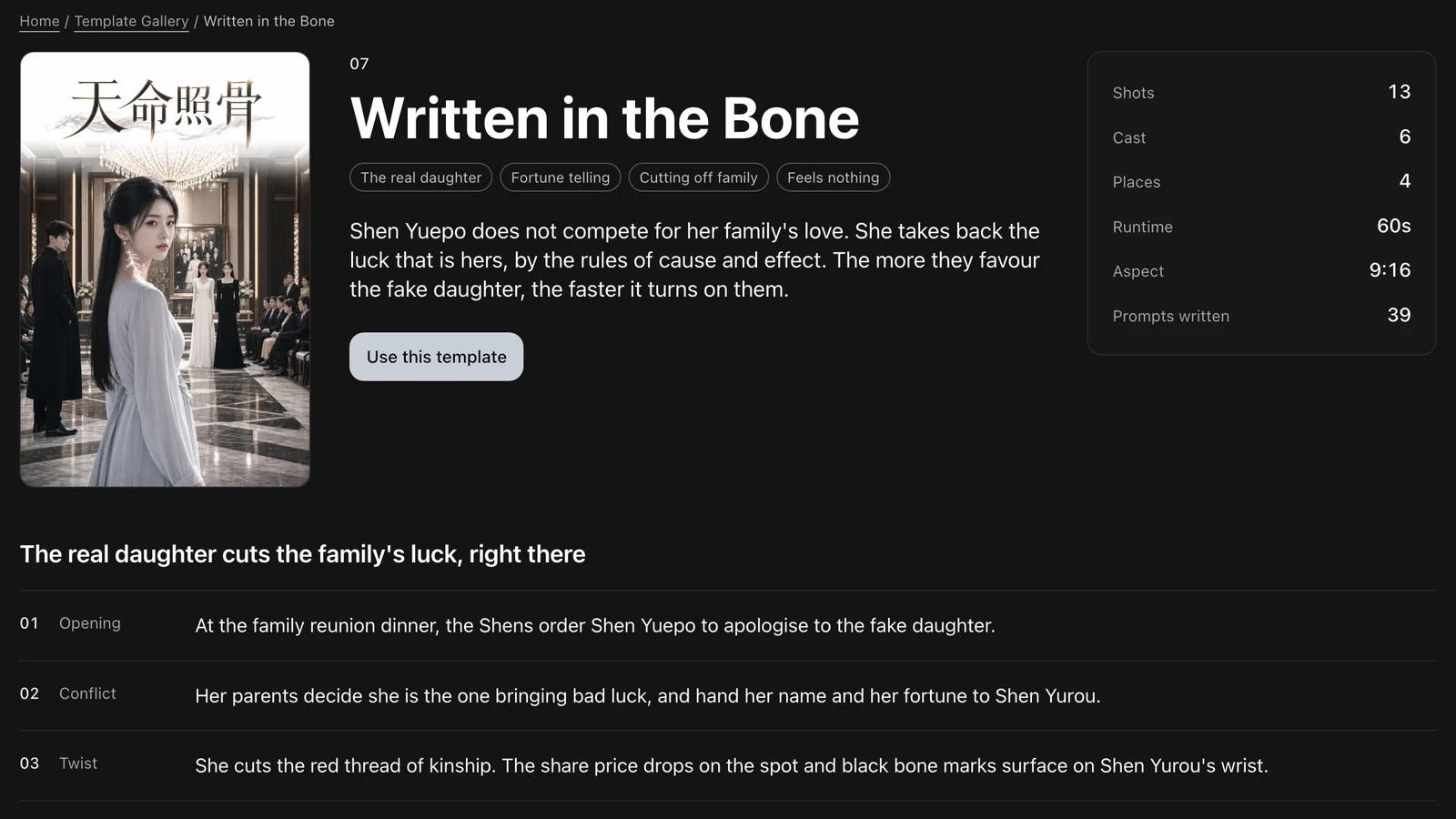
The numbers below come off twenty finished pilot episodes sitting in this product. Every one of them is 60 seconds and 13 shots, across 4 scenes, with 4 to 6 named characters. Two hundred and sixty shots between them. That is not a rule of the universe, it is what actually worked, and it is a much better starting point than a blank page.
The shape of one episode
The first shot is three seconds long. Every shot after it is four or five. That is not a stylistic tic, it is the hook: whatever makes somebody stop scrolling has to arrive before the fourth second, and a three-second opening forces the writing to put it there instead of building up to it.
Thirteen shots inside sixty seconds means the average shot is under five seconds. Nothing in an episode gets to breathe, which is the format, not a compromise. Four scenes across thirteen shots means roughly three shots per location, so a scene change is a real event rather than a shuffle.
| What it is | The number | Where it comes from |
|---|---|---|
| Episode length | 60 seconds | All 20 pilots, identical |
| Shots in one episode | 13 | All 20 pilots, identical |
| First shot | 3 seconds | The hook, before anything is explained |
| Every other shot | 4 or 5 seconds | Shot 2 through 13 |
| Scenes | 4 | About three shots per location |
| Named characters | 4 to 6 | 83 across the twenty pilots |
| Episodes mapped ahead | 3 per pilot | So episode two is already sketched |
| Generation prompts written | 780 across the twenty | Two per shot plus motion |
Counted from the twenty pilot files in this product on August 18, 2026.
Try generating with H3 Max TurboThe order the work happens in
Story first, and it is short. A premise, then the four beats that carry it: the opening, the conflict, the twist and the hook that makes somebody want episode two. Four lines. If those four lines are boring, no model fixes it.
Cast second, and this is the step people skip. Each character becomes a reference image before any shot is generated, because that image is the only thing that makes shot eleven show the same person as shot two. Describing a character in words each time gives you a different person each time.
Places third, for the same reason. A room that is described rather than pinned looks like a different room every time somebody walks into it.
Shots last. Only now does the shot list get written, thirteen of them, each carrying its own frame description, camera move, light, dialogue and the character references it binds to. Then they get generated, and the generating is the fastest part of the whole thing.
The three places it usually goes wrong
Generating before casting. This is the big one. If you start making shots and decide the characters as you go, you have no reference to hold them to, and by shot nine the lead is a different person. Fixing that later means regenerating most of the episode.
Writing a two-minute story into a sixty-second slot. The beats do not compress, they just get rushed, and every shot ends up explaining rather than showing. If the premise needs more room, it is a three-episode arc, not a longer single episode.
Spending the expensive model everywhere. A wide establishing shot and a close-up on a face do not need the same model. Putting a cheap model on the wides and an expensive one on the faces is the single biggest lever on what an episode costs, and it changes nothing a viewer notices.
What the generating part costs
The unit is one generation, so the number to hold is the price of one shot. A 5-second 720p shot is 2.94 credits on the cheapest video model in the picker and 82.78 on the dearest. Same five seconds, a 28x spread, and you choose it per shot.
That spread is why the model choice matters more than anything else you do about cost. It is also why the price of the generation you are about to run sits on the Generate button before you confirm it: you set the model, you watch the number move, and you decide. Nothing quotes you a total for work you have not run.
A free account starts with 40 credits and no card, which on the cheapest model is thirteen 5-second shots. That is enough to find out whether the thing you wrote is any good.
Free to start
40 credits when you sign up
40 free credits, yours for 14 days. Go make something great.
- SOTA models
- Infinite canvas
- Director stage
- MCP access
Got questions left?
Does every episode have to be 60 seconds and 13 shots?
No. That is what twenty finished pilots landed on, not a rule. It is a good default because it fits the vertical feeds people watch these on, and because thirteen shots is enough to carry four scenes without any of them feeling skipped. Longer works when the story needs it.
Why does the first shot have to be shorter?
Because whatever makes somebody not scroll away has to have already happened. A three-second opening does not leave room for a build-up, which forces the interesting thing to the front. In all twenty pilots the first shot is three seconds and every shot after it is four or five.
Can I write the story myself instead of generating it?
Yes, and it is usually better. The script stage is there to get you from a premise to a shot list quickly, not to take the writing away from you. Every line, every beat and every shot stays editable, and a rewritten scene only regenerates the shots it touched.